What is the Gameday +/- system?
The gameday +/- system can be simply explained as a weekly layout design. It classifies each training day relative to its proximity to a game. This allows each day to emphasize (or blend) tactical preparation, training stimuli, recovery methods, etc. The purpose of the design is to promote appropriate balance of physical and tactical loading throughout the week.
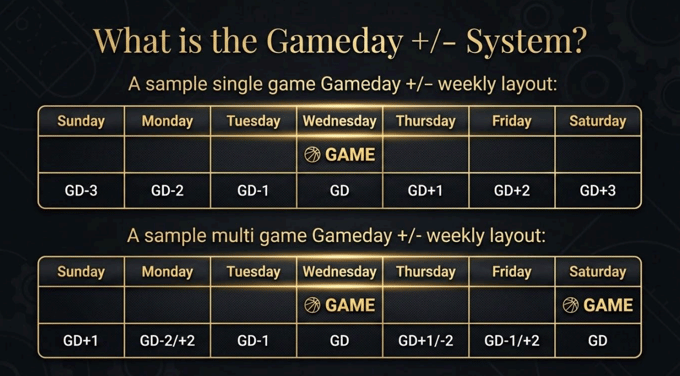
Gameday (GD) is the center piece of the system. The days after a game are designated with a “+” followed by the number of days after competition. For example, the day after a game would be tagged GD+1. The same concept applies for the days before a game, which would be designated with a “-“ followed by the number of days preceding the competition. The day before a game would be tagged GD-1.

If there are multiple games in a single week, the closest proximity to a game would take precedence. If we were one day after a game and two days before the next game, it would be tagged GD+1/-2. Below is a visual to assist with building single game and multiple game weeks.
Conceptualizing GD+/- from Soccer to Basketball Models
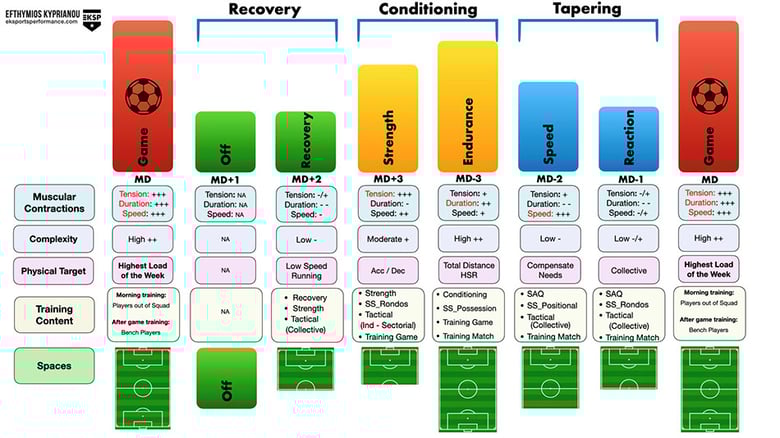
This system was originally developed for soccer, particularly around matchday periodization (+/-). After studying established soccer models, several key components emerged as essential for adapting the framework to basketball. These components include Theme of the Day, Targets, Practice Content, Space, and Volume/Intensity.
-
Theme refers to the central focus or objective of the session—what the day is ultimately designed to accomplish.
-
Targets represent the key performance metrics or team-specific goals for that session.
-
Practice Content outlines the specific drills, activities, or tactical elements being trained.
-
Space defines the playing area or number of players involved in the practice environment.
-
Volume and Intensity provide a snapshot of the session’s overall workload (e.g., high volume / moderate intensity).
Together, these components create a structured framework for planning and evaluating basketball training sessions with the same clarity and efficiency found in soccer periodization models.
The following images are great summaries of these components from Efthymios Kyprianou and Daniel Bove.
 (Image from Efthymios Kyprianou)
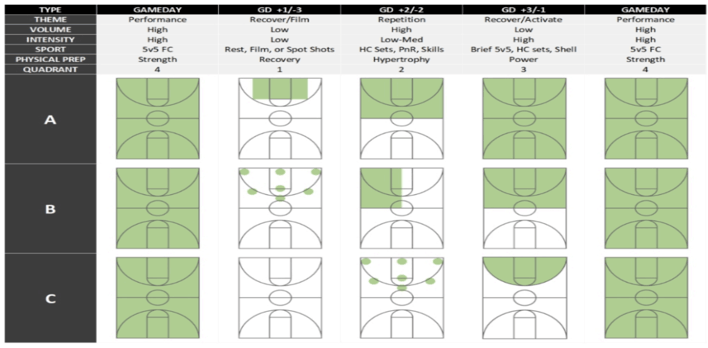 Image from Daniel Bove (Figure 49 -3 days between contests)
Integrating into Wake Forest Women’s Basketball
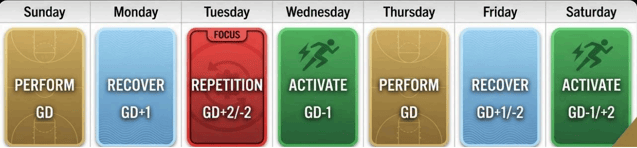
I will be using our ACC weekly schedule as our planning example (there are two games on Thursday and Sunday each week). The first key component of integrating the GD+/- system is to identify themes and assign them to a day. A simple representation of our themes are the following (from Daniel Bove’s Quadrant system): Perform, Recover, Activate, Repetition. We then assign them to days of the week using the GD+/- system (see below). In a typical week, Tuesday is our designated off day.
Identifying targets for themes can take some time and include an interdisciplinary team effort. At Wake Forest, some of our identified targets include:
- Sport Science: Player Load, Player Load per Minute, Estimated Distance,
Accelerations/Decelerations, Change of Direction Left/Right, and IMA/s -
Tactics: Scout Readiness, Skill Development/Maintenance, Gameplay/Game Simulation, and High and Low Minute Splits
-
Sports Performance: Lift/Conditioning Objectives, Recovery Modalities, and Readiness Assessments
These targets provide us with metrics, perspectives, and frameworks to build the most efficient day to match the themes in the Gameday +/- system. For example, we have high/low team splits on game days and GD+1 days. This makes sense as some athletes will play more minutes than others and the following day that difference should be addressed in our planning. For example, this can be an extra exposure of game play simulation for our low minute players and extra recovery modalities for our high minute players. A more expansive overview of our week is below.
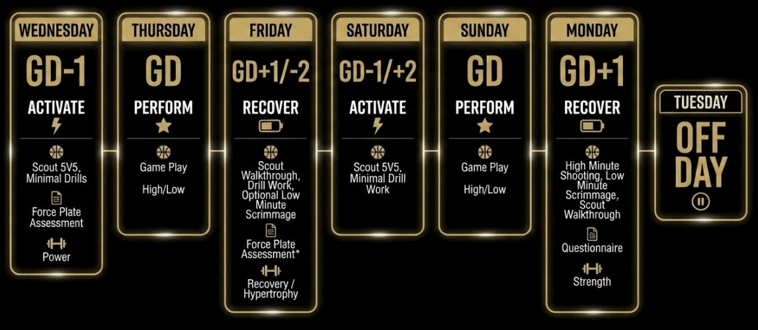
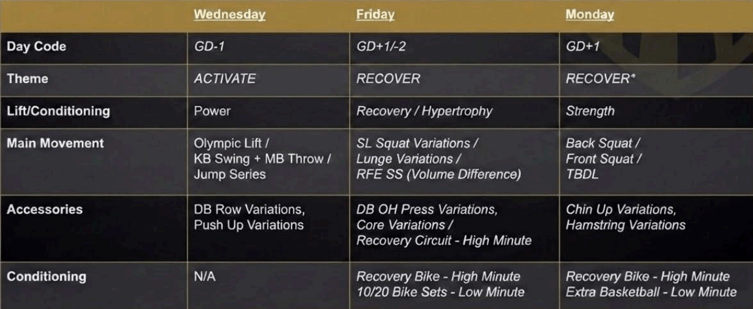
At this point, our weekly layout is set and as strength and conditioning professionals we can focus on our sessions. As you saw above, we have 3 training sessions during a typical week. Each session caters to the overall theme of the day. It is important to note that our GD+1 (Monday) and GD+1/-2 (Friday) differ because of where they fall during the week.
Even though our theme is recovery for our Monday session, the following day is an off day. This provides the most optimal opportunity to strength train. Friday sessions take place between two games, so it is important to facilitate recovery and get minimal volume training in. Our Wednesday session is the first activity of the week (GD-1) and the most optimal time to train power. Below is a layout of the lifting sessions from the 2023-2025 seasons.
Review of the Gameday +/- System in the 2024-2025 Season
The Gameday +/- System serves as a comprehensive framework for planning and executing strategies that optimize conditions for competition, practice, training, and recovery. Its fluid design allows for adaptability when facing last-minute schedule changes or unforeseen circumstances. I strongly recommend implementing a framework with similar principles for any team environment.
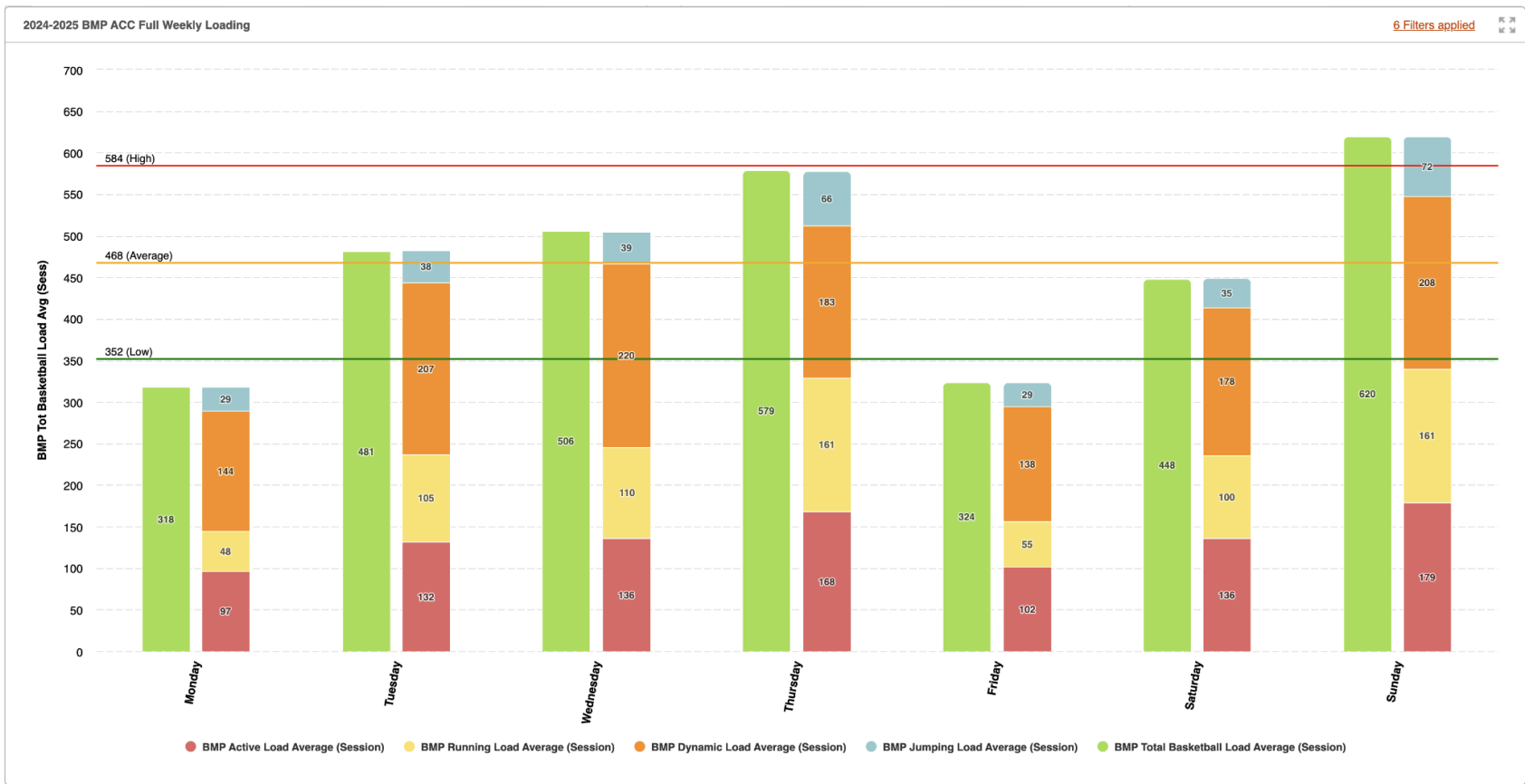
Over the past season, we observed significant improvements across multiple performance areas, including force plate assessments, strength and conditioning benchmarks, and Catapult performance metrics. The chart below presents Catapult’s Basketball Movement Profile (BMP), illustrating our average training load distribution throughout ACC conference play. The data highlights how the system’s daily themes directly influenced workload management and performance outcomes.
While there remains room for continued growth in several areas, this approach has marked a major step forward in the integration and application of structured performance systems within Wake Forest Women’s Basketball.

6 Programs That Your Athletes Can Do At Home
Raising the Bar for Strength & Conditioning Internships