Low back pain shows up constantly in the tactical populations I coach, and while it is common, coaches and providers also commonly misunderstand it. Athletes often arrive convinced their back is damaged, unstable, or worn out because of something they saw on an MRI or something a provider told them years ago. Those messages stick, and once they take root, they shape how an athlete moves, trains, and thinks about their own body. The problem is that most of those messages are incomplete at best and misleading at worst. Low back pain is not a diagnosis. It is a symptom, and symptoms tell us where discomfort is happening, not why it exists. My job is not to diagnose injuries. My job is to rebuild capacity and to get the athlete from A to Z on the performance continuum.
Tactical athletes live inside a world where stress is constant and unavoidable. Long shifts, heavy gear, unpredictable schedules, sleep disruption, and occupational demands all stack up. When pain appears, blaming a single lift or a single moment is easy, but pain rarely comes from one isolated event. It almost always reflects total workload exceeding current capacity. That means the solution is not avoidance. The solution is strategic, progressive exposure that respects irritability while rebuilding tolerance. My hope is that at the end of this article, you will leave here with a better understanding of low back pain, what our role as coaches is, and how to fix it in a variety of different scenarios and situations.
Section 1: Low Back Pain Is a Symptom, Not a Diagnosis
When I talk to clients and athletes about low back pain, the first thing I explain is that pain tells us location, not cause. Pain is an output of the nervous system influenced by physical, psychological, and environmental factors. When coaches treat pain like a diagnosis, they end up chasing anatomy instead of addressing function. This is unfortunately one of the biggest problems I have with the physical therapy profession. I have seen athletes lose months of training because a provider told them their pain must be coming from a disc, a joint, or a nerve, even though none of those explanations changed how they moved or how they responded to load. Then the fearmongering begins.
“Your core isn’t strong enough to protect your spine.”
“I don’t care what you’ve done before. You’re not loading your spine under any circumstances.”
“This is something you’ll deal with for the rest of your life.”
"Your back will never be the same again."
“Heavy lifting is dangerous for your spine. High volume is the only safe way you can train now.”
All of these are quotes I have actually heard from PTs I have worked alongside in the past. Countless contributors feed into low back symptoms. Discs, muscles, ligaments, joints, nerves, sleep, stress, recovery, workload, previous injury, and fear avoidance all play a role. Coaches often search for one "root cause" of low back pain, such as a weak core, poor posture, or a bulging disc. Current evidence suggests the problem is rarely that simple. An umbrella review evaluating 54 potential risk factors found that 38 showed an association with future low back pain, highlighting that numerous interacting biological, psychological, lifestyle, and occupational factors influence pain rather than a single cause (Parreira et al., 2018). These factors interact in ways that are not always obvious. I have coached athletes who were convinced they had a structural injury, only to discover that fatigue, poor sleep, or a spike in occupational stress drove their symptoms. I have also coached athletes with disc bulges who had zero symptoms and moved without limitation. Pain is multifactorial, and that is exactly why trying to identify a single structure as the source of pain is usually a dead end. Instead of asking what structure is injured, I ask what the athlete can currently tolerate. As coaches, leave the medical diagnosis to the doctors and physical therapists. We should program from function, not assumptions.
Section 2: Stop Programming from the MRI
I have seen MRIs derail more athletes than injuries ever have. Imaging regularly shows disc bulges, degeneration, and arthritis in people with no pain at all. If you've ever had an athlete tell you, "I have a bulging disc, so I can't squat anymore," it's worth remembering that MRI findings don't always match what an athlete feels or can do. Brinjikji and colleagues (2015) showed that structural changes like disc degeneration, bulges, and protrusions are surprisingly common in people with no pain at all. As coaches, our job isn't to chase MRI findings. Our job is to build movement confidence, improve load tolerance, install correctives where necessary, and progressively increase an athlete's capacity.
These findings are normal age-related changes, not automatic red flags that coaches will commonly run into inside the tactical populations. They are often incidental and unrelated to symptoms. On the other hand, athletes with severe pain often have normal imaging. This disconnect matters because it highlights a simple truth: MRI findings do not equal pain, and pain does not equal tissue damage. Does all this mean we should completely ignore findings when they come up? Absolutely not. Coaches should view imaging as a data point to consider inside the S&C program.
When coaches program from imaging alone or fear-based concerns from non-S&C personnel, they limit athletes unnecessarily. This does not mean program irresponsibly. A disc bulge does not mean someone cannot squat. Degeneration does not mean they cannot deadlift. Arthritis does not mean they cannot hinge, carry, or load their spine. These findings do not dictate movement capability. What matters is the athlete's presentation. Movement quality, irritability, load tolerance, and recovery tell me far more than any scan ever will. Yes, there are times when I do not want to squat. Yes, there are times when I cannot deadlift my tactical athletes.
This does not mean that they cannot train and that we as practitioners cannot find ways to use the overload principle to progress training stimuli and allow good doctors and physical therapists time and room to do their work. I program according to what the athlete can do, not what their MRI says. The MRI is one data point in a multifactored equation. When coaches stop letting imaging dictate training decisions, athletes regain confidence, move better, and return to performance sooner.
Section 3: The Real Goal Is Building Capacity
Capacity is the foundation of resilience. It represents the athlete's ability to tolerate stress across training, occupation, and life. When capacity is high, athletes absorb stress without symptoms. When capacity is low, even small stressors can trigger pain. Capacity is not just strength. It includes endurance, movement quality, recovery, confidence, and work capacity. All of these elements interact to determine how much stress an athlete can handle before symptoms appear. When I explain this to athletes, they immediately understand why rest alone never solves the problem. Rest reduces stress, but it also reduces capacity. The majority of the time, the injuries come back once detraining starts because they never fixed the problems to begin with.
Athletes do not get injured because they lifted once. They get injured because stress exceeded capacity. This is the central principle I teach. When stress rises through training, occupational demands, life stress, or poor recovery, and capacity drops, symptoms appear. The solution is not avoidance. The solution is to rebuild capacity so the athlete can tolerate stress again. Tactical athletes face unique cumulative stressors. Strength training, flying, gear load, sleep loss, and life stress all contribute to total workload. Unlike traditional athletes, tactical athletes cannot simply rest when symptoms appear. Their job continues. Before I write a workout, I ask myself what stress already exists before I write the next four weeks of their programming. That question keeps me honest and ensures I respect the athlete's total workload.
Section 4: Four Questions I Ask Before Programming
I rely on a simple four-question framework to guide how I program around symptoms. This keeps training productive, safe, and aligned with the athlete’s real-world demands instead of reacting emotionally to pain. When I walk through these questions, I’m able to match the training dose to the athlete’s irritability, choose movements they can tolerate, evaluate how they responded afterward, and adjust based on the occupational stress they’re carrying that week. This framework keeps training moving forward without overcorrecting every time symptoms show up.
FourQuestion Programming Framework
|
Movement Question |
What I’m Evaluating |
How It Guides Training |
|
How irritable are symptoms? |
Sensitivity to load, speed, ROM, and position |
High irritability means lower volume, slower tempo, shorter ROM. Low irritability allows more aggressive loading. Irritability determines the dose, not the movement. |
|
What movements are tolerated? |
Which patterns feel stable, controlled, and repeatable |
I build the session around tolerated patterns. If an athlete can hinge but not squat, I hinge. If they can carry but not deadlift, I carry. Tolerance sets the plan. |
|
How did symptoms respond after training? |
Postsession irritability within 24 hours |
If symptoms settle within a day, the dose was appropriate. If symptoms spike or linger, I adjust volume, tempo, or ROM. I care more about after than during. |
|
What occupational demands are coming this week? |
Shifts, flying, gear load, sleep disruption, travel, heavy lifting |
Tactical athletes train inside realworld stress. I adjust training based on the demands they’re already carrying so total workload stays manageable. |
Section 5: Modify the Dose Before Removing the Exercise
Before You Remove an Exercise, Modify the Dose
One of the biggest mistakes I see coaches make is removing an exercise the moment it becomes uncomfortable. More often than not, the movement itself is not the problem. The amount of stress being applied is. Before you eliminate a squat, deadlift, carry, or other foundational movement, ask whether you can simply modify the dosage while preserving the movement pattern. Small adjustments often allow athletes to continue training, maintain confidence, and gradually build the capacity needed to return to full performance.
|
Programming Variable |
Modification |
|
Load |
Reduce the weight while maintaining sound technique. |
|
Range of Motion |
Temporarily shorten the movement and gradually restore full depth. |
|
Tempo |
Slow the eccentric phase or add pauses to improve control. |
|
Volume |
Reduce the number of working sets or repetitions. |
|
Frequency |
Increase recovery time between loading sessions. |
|
Exercise Variation |
Use supported or unilateral variations while maintaining the same movement pattern. |
My goal is always to preserve meaningful movement whenever possible. Removing an exercise is a last resort, not the first response. In many cases, simply adjusting the load, range of motion, tempo, volume, frequency, or exercise variation allows athletes to continue developing strength, confidence, and resilience while respecting their current level of tissue tolerance.
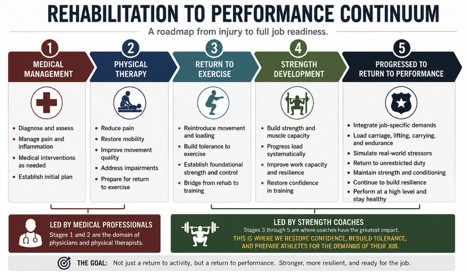
Section 6: Rehabilitation to Performance Continuum
This continuum below outlines the phases an athlete moves through after injury. Coaches have the greatest influence during stages four through six, where strength, capacity, and occupational readiness are rebuilt. Stages one and two belong to medical professionals. Stages three to five belong to the S&C staff. This is where we restore confidence, rebuild tissue tolerance, rebuild strength, and prepare athletes for the demands of their job. On an important coach's note: still involve the medical and PT staff on your side of the continuum as the athlete progresses in rehab. Problems can come up at any point, and maintaining great communication is never a downfall.
Section 7: Programming by Presentation
A practical framework for adjusting training is based on acute, mild, and chronic low back symptoms. My job in all three phases is the same: keep athletes moving, keep them confident, and keep the training stimulus alive without poking the bear. The specifics change, but the mission stays consistent.
Acute Low Back Injuries
When an athlete shows up with an acute low back flare, my first priority is simple: calm things down without shutting them down. If I take everything away, they get stiff, scared, and convinced their spine is made of glass. If I keep them moving in predictable, supported ways, they usually realize pretty quickly that they're not broken, just irritated. Acute backs react fast to changes in load or position, so I lean on shortened ranges, slower tempos, and simplified bar paths. I watch the 24-hour response like a hawk because the response tells me whether I nailed the dose or need to dial it back. My goal here isn't to make pain vanish overnight. It's to keep confidence high and movement patterns alive while symptoms settle. And yes, I show them regressions, progressions, and alternates right away, so they know training isn't canceled. It's just edited.
Acute Progression Grid
|
Movement |
Regression |
Progression |
Alternate Exercise |
|
Squat |
Front squat |
Back squat |
Belt squat |
|
Bench |
Feet up bench |
Paused bench |
Floor press |
|
Deadlift |
Rack pulls above knee |
Rack pulls below knee or sumo deadlift |
Trap bar deadlift with high handles from block |
|
Clean |
High hang clean |
Hang clean |
Clean pull from blocks |
|
Jerk |
Push press |
Power jerk |
Landmine split jerk, power jerk, or push press |
|
Snatch |
Hang snatch high pull or hang power snatch (above knee) |
Hang snatch high pull or hang power snatch (below knee) |
Snatch pull from blocks (above knee) |
Mild Low Back Injuries
Once symptoms are mild, I shift gears. This is the phase where athletes start trusting their back again, and I want to reinforce that trust every chance I get. I will reintroduce squatting, benching, deadlifting, and Olympic lift variations with more structure and intention. I gradually increase load, range of motion, and volume while keeping an eye on how they feel later that day and the next morning. Tempo work, moderate intensities, and consistent exposure help expand tolerance without overwhelming the system. This is also where athletes start realizing their back is capable, adaptable, and not nearly as dramatic as it pretends to be. I lay out regressions, progressions, and alternates so they can see exactly how their training will evolve as symptoms improve.
Mild Progression Grid
|
Movement |
Regression |
Progression |
Alternate Exercise |
|
Squat |
Tempo goblet squat |
Front squat with moderate load |
Safety bar or front racked split squat |
|
Bench |
Pin bench |
One board bench |
Alternating dumbbell incline bench |
|
Deadlift |
High handle trap bar |
Low handle trap bar |
Sled push or Glute Bridge (Shoulders Elevated) |
|
Clean |
Hang clean pull above knee |
Hang clean pull at or below knee |
Clean pull plus front squat |
|
Jerk |
DB OH Press |
BB or DB Push Press |
½ kneeling or kneeling landmine press |
|
Snatch |
Hang snatch pulls above knee |
Hang snatch pull at or below knee |
Behind the neck snatch overhead press plus overhead squat |
Chronic Low Back Injuries
Chronic low back issues are a different animal. These athletes have usually been dealing with symptoms for months or even years, and by the time they get to me, they've collected a whole museum of beliefs about their back being fragile. Spoiler alert: it's not. Chronic backs don't need magic. They need consistency, progressive loading, and exposure to the movements they've been avoiding. I focus on full ranges of motion, conditioning under load, and building real-world capacity that matches their job or sport.
Olympic lifts stay out until they're cleared because complexity plus fear is a recipe for disaster. Early on, I use heavier reductions to limit axial load while still giving them meaningful work. The goal is simple: rebuild resilience, physically and mentally, and get them back to moving like someone who trusts their body again.
Chronic Progression Grid
|
Movement |
Regression |
Progression |
Alternate Exercise |
|
Squat |
Goblet squat to front squat |
Back squat with moderate to heavy load |
Belt squat with heavy load |
|
Bench |
Feet up close grip bench |
Competition bench |
Pin press |
|
Deadlift |
Dowl Rod RDL (tempo) |
SL DB RDL (with tempo) |
Glute Bridge (Shoulders on floor, if hinge pattern causes issues) |
|
Clean |
Removed until cleared |
Removed until cleared |
Removed until cleared |
|
Jerk |
Removed until cleared |
Removed until cleared |
Removed until cleared |
|
Snatch |
Removed until cleared |
Removed until cleared |
Removed until cleared |
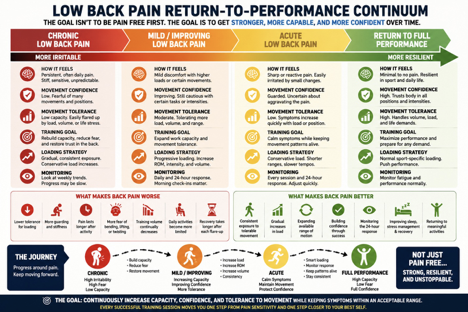
This continuum is how I think about managing low back pain in athletes and tactical professionals. My goal is not to chase a pain free training session every time, but to gradually improve movement tolerance, confidence, and physical capacity while keeping symptoms within an acceptable range. Some athletes move through these phases quickly, while others need more time, but the process always follows the same principle of meeting them where they are and progressing from there.
Section 8: Five Coaching Principles
These principles guide every decision I make and anchor my approach to coaching tactical athletes.
- Treat the athlete, not the MRI.
- Pain is information, not failure. (Physical therapy is supposed to be physical. It is okay to go up and down throughout the process.)
- Capacity solves more problems than avoidance.
- Modify exercises before removing them.
- Return athletes to performance, not just participation.
My role as a strength coach is not to diagnose injuries. It is to rebuild capacity. Low back pain is a symptom, not a verdict, and tactical athletes need coaches who understand how to load, progress, and build resilience. Medical clearance does not equal performance readiness. Progressive overload still applies. Movement remains medicine when appropriately dosed. Tactical athletes operate in high-stress environments, and their training must reflect the realities of their job. When coaches understand workload, irritability, tolerance, and capacity, they can guide athletes from symptoms back to full performance. The goal is not simply reducing pain. It is restoring the strength, confidence, and resilience required for operational readiness. For coaching support or collaboration, please feel free to reach out to me at:
Email: CoachKostaTelegadas@Gmail.com
Instagram: Coach_Telegadas
References:
Brinjikji, W., Luetmer, P. H., Comstock, B., Bresnahan, B. W., Chen, L. E., Deyo, R. A., Halabi, S., Turner, J. A., Avins, A. L., James, K., Wald, J. T., Kallmes, D. F., & Jarvik, J. G. (2015). Systematic literature review of imaging features of spinal degeneration in asymptomatic populations. American Journal of Neuroradiology, 36(4), 811–816. https://doi.org/10.3174/ajnr.A4173
Hartvigsen, J., Hancock, M. J., Kongsted, A., Louw, Q., Ferreira, M. L., Genevay, S., Hoy, D., Karppinen, J., Pransky, G., Sieper, J., Smeets, R. J., & Underwood, M. (2018). What low back pain is and why we need to pay attention. The Lancet, 391(10137), 2356–2367. https://doi.org/10.1016/S0140-6736(18)30480-X
Parreira, P., Maher, C. G., Steffens, D., Hancock, M. J., & Ferreira, M. L. (2018). Risk factors for low back pain and sciatica: An umbrella review. The Spine Journal, 18(9), 1715–1721. https://doi.org/10.1016/j.spinee.2018.05.018
Silva, J. R., et al. (2024). Associations between lifestyle-related risk factors and back pain: A systematic review and meta-analysis of Mendelian randomization studies. BMC Musculoskeletal Disorders. https://doi.org/10.1186/s12891-024-07663-9

5 Mistakes I Made as a Young Strength Coach

Building a D1 Strength Program From Zero: 3 Lessons From a First-Year Coach