Rachel Newman is a marketing professional and strength and conditioning practitioner whose work sits at the intersection of sport, performance, and the people behind it. She would like to thank her fellow coaches for their roles as devil's advocates and proofreaders. She couldn't have done it without them, or at least it would have been a lot worse.
What responsible AI adoption actually looks like when athletes' data is on the line.
Strength and conditioning coaches are getting real work done with AI. Programming blocks are being drafted in minutes instead of hours. Protocols are outlined without extended time staring at a screen. Research is summarized, templates generated, and administrative tasks that eat into floor time are getting handled in the background. The question isn’t whether to use AI. That ship has sailed, and the coaches leading the way are getting better for it. The question is how to use it in a way that protects the athletes the work is built around.
The Ownership Question Nobody Has Answered
Here's something worth sitting with before we get into the practical stuff: we must understand who owns athlete performance data.
The institution pays for the software. The coaching staff designs the tests. The sport scientist collects and interprets the output. But the athlete is the one whose biometrics are being measured, and that data is uniquely, personally theirs. Granular performance metrics, readiness scores, HRV trends, force plate outputs: this is information that can identify an individual, describe their physical state, and in many cases directly affect decisions about their career.
Ask a room full of coaches who that data belongs to, and you'll get different answers. That inconsistency is a problem in itself. Because when there's no shared understanding of ownership, there's no consistent standard for protection, and that's the environment most AI tools are being dropped into right now.
The moral answer is clear: athletes have a right to understand how their data is collected, where it goes, and how it informs decisions about them. The legal answer is still being worked out. Which means right now, the burden falls on coaches and programs to do the right thing before the rules require it.
What the Legal Landscape Actually Covers
It's worth understanding what protections currently exist and where the gaps are.
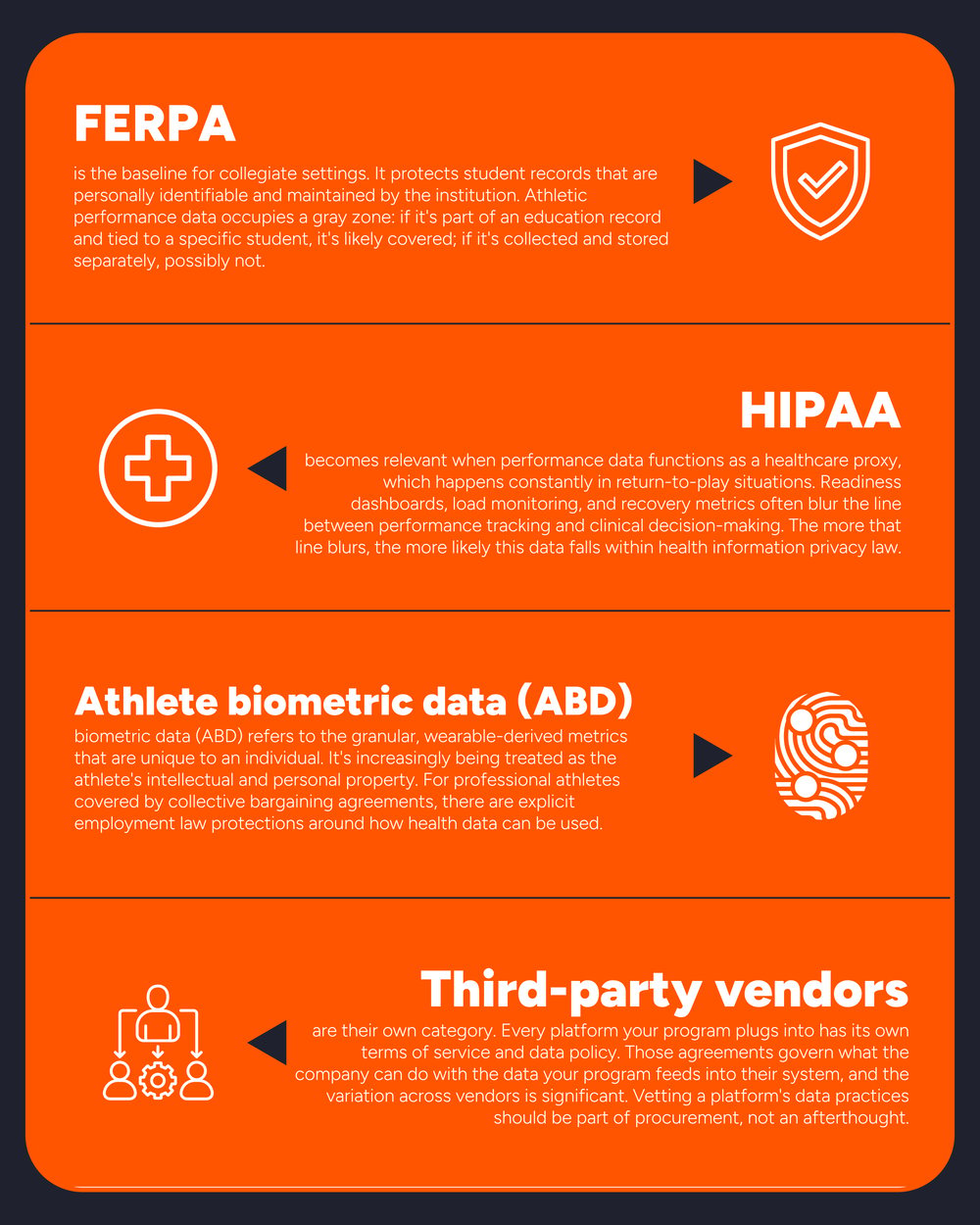
The summary: current law provides a floor, not a ceiling. The good news: programs that build practices above that floor are ahead of where regulation is heading.
Where AI Adds a Layer Worth Understanding
AI tools can extend what coaches do, especially for those working under the constraints of limited funding, understaffing, and the ever-growing need to justify their roles. That is not in question. But there is one dynamic worth understanding before it is built into a program’s workflow.
When a coach opens a consumer AI product and starts typing, they're interacting with a third-party system that has its own data storage, usage, and retention policies. Many free-tier tools use input data for model training by default. Meaning, the content a coach types in can be absorbed into the model and potentially surface in future outputs or in a breach outside the institution.
Understanding where data goes isn’t about distrust of these tools. It is about using them with the same intentionality coaches bring everywhere else in their programs.
How to Build Responsible AI Habits
None of this requires avoiding AI; however, it requires using AI with intention and thoughtfulness.
Anonymize before you input anything. Remove names, team affiliations, specific dates, and any combination of details that could identify an individual. In practice, this is having your agent of choice assign random numerical IDs and maintaining a scrubbed duplicate of any sheet you’re working from. You can still be highly specific about age, position, injury type, and training history.
Read the data policy of any tool you use regularly. Most platforms give you options: usage-based data collection can often be turned off, and enterprise plans typically include stronger privacy agreements than free consumer tiers.
Work with your administrator and IT to formalize vendor agreements. This is the highest-leverage step you can take. By establishing an agreement and Data Processing Agreements (DPAs) with AI vendors, you’re creating a formal contractual relationship that defines exactly how data can and cannot be used. AKA: Liability is shifted away from you, as the individual coach, to the organization, which is protection for the coaches on the ground doing the work.
Keep individual athlete records in purpose-built software. AI tools are useful for generating frameworks, templates, and ideas. Session notes, injury logs, performance histories, readiness data: that lives in your athlete management platform.
The drafting table and the filing cabinet are not the same thing.
Be transparent with your athletes about how their data is used. Athletes should understand what's being collected, how it informs decisions about their training, and which tools their information flows through. Like everything coaches who are doing the work use, AI is being used to get them better outcomes with their training.
Bring context to every data handoff. The output is only as useful as the interpretation behind it. Raw metrics without context can be misread. The tool accelerates the work; the coach is still responsible for the call.
The Data Quality Angle
There's a separate but related issue: The model doesn’t know your athletes like you do.
Every AI-generated recommendation is based on general training data, population-level patterns that have nothing to do with your program's specific context, your team's history, or the person behind the readiness score. The confident-sounding output doesn't reflect the relationship you’ve built or the four years of training data you have on your senior class. It reflects pattern matching on whatever it was trained on.
The coaches getting the most out of AI aren’t the ones with the best prompts: they’re the ones with the best data. We learn in our strength and conditioning education that your conclusion is only as good as the data collected. Clean, structured athlete records are what turn a generic ChatGPT prompt into something that reflects the weight room you have built.
Every workflow AI can accelerate requires data as the input. Without it, you’re generating reasonable-sounding recommendations with no connection to what was actually completed. Your training history, your benchmarks, your athlete individualization: that is the institutional knowledge where the infrastructure for the whole workflow lives. The platform where that data lives matters as much as the AI tool sitting on top of it.
What's Coming
The legal and regulatory landscape is moving. State-level data privacy laws are expanding. Litigation around athlete biometric data rights is developing. Institutional policies on AI in sport are starting to take shape.
Programs building responsible habits now, before the regulations arrive, will be ahead of it rather than reactive to it. The athletes in those programs will have experienced something worth something: a staff that treated their data with care, not because a policy required it, but because the relationship demanded it.
The access strength coaches have to athletes' physical and performance information is built on proximity and trust. AI expands what coaches can do with that information. It doesn’t change what that relationship requires.
The 4 Step Guide For Strength Coaches Getting Started With AI
Is AMS Cooked? AI Has Entered the Chat